



Want to stay in the loop on training events? Click here to join the mailing list
Workshop collaboration with Women in Cognitive Science (WiCS) Europe! Join the WiCS community and join our training sessions.
Lots of helpful tutorials on youtube! Click here to see
Home
📬 Stay in the loop
Want to stay in the loop on workshops and training events? Join the mailing list!
🎓 Official PsychoPy Workshop (Virtual - Online training)
2026 dates - October 13th - 16th 2026
2027 dates - April 13th - 16th 2027
Join us for an intensive, hands-on course in designing behavioural experiments — delivered by the creators of PsychoPy and Pavlovia.org.
Format: Four half-day sessions (13:00–17:00 UK time), covering two full days worth of post-graduate level training.
Who is it for: This workshop is ideal for beginners, PhD students, faculty, and industry researchers interested in using PsychoPy. No prior experience is required, though downloading the software in advance for familiarization is recommended. Experienced users will also benefit from advanced tips and best practices. Bespoke training options are available on request.
What you’ll learn:
How to design and run experiments studying human behaviour (reaction times, accuracy, and more).
Integrating Python code for flexible, customisable experiments.
Running experiments online via Pavlovia.org for large-scale recruitment.
Connecting experiments with hardware for physiological measurements (EEG, fMRI, eyetracking).
Whether you’re starting out with behavioural research or looking to refine your skills, this course offers interactive training and expert guidance from the team behind PsychoPy and Pavlovia.org.
Spaces are limited
Interested in attending but these times don’t work for you? Let us know what timezones work for you in this form — if we get enough requests, we will make something work!
👩💻 My First Pull Request
📅 October 1st, 12:00–13:00
🌐 Virtual
Learn how to contribute to Open Source code in a friendly environment.
This is a free workshop in which we will walk you through the very basics of git and how to make a pull request to github repositories. By the end of the session, we hope that you will have made a pull request to the PsychoPy documentation.
Note: This is not a workshop designed to teach you about PsychoPy or Pavlovia, the focus is on GitHub basics.
One-to-one tutorials
If you need to create a task for a specific project, but you’de like to learn along the way, build it with us!
Brief us on your project.
We create bespoke material on how to create your paradigm.
One-to-one video calls to co-create your task.
Learn PsychoPy and/or Pavlovia, and leave with your experiment!
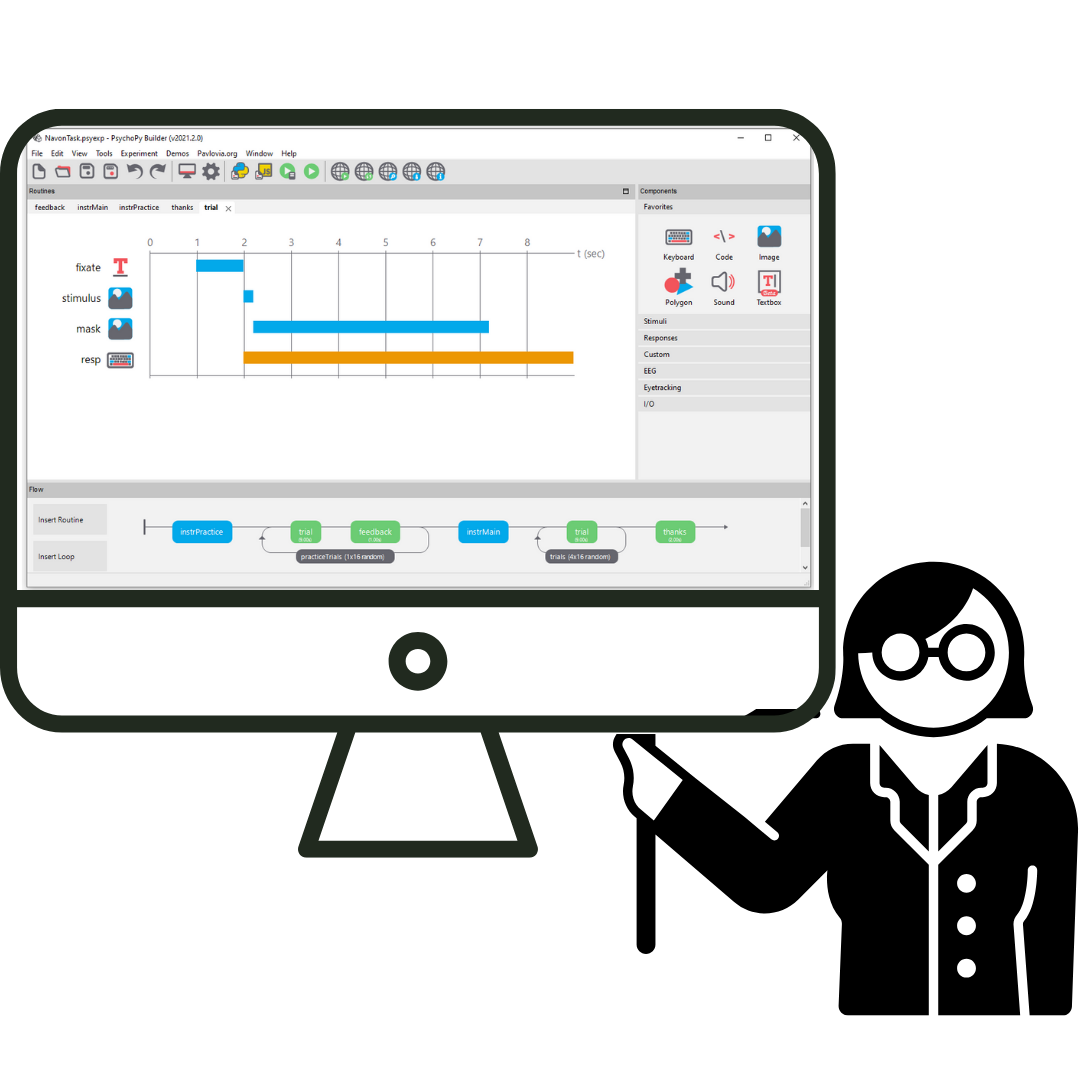
Arrange a workshop for your lab or department
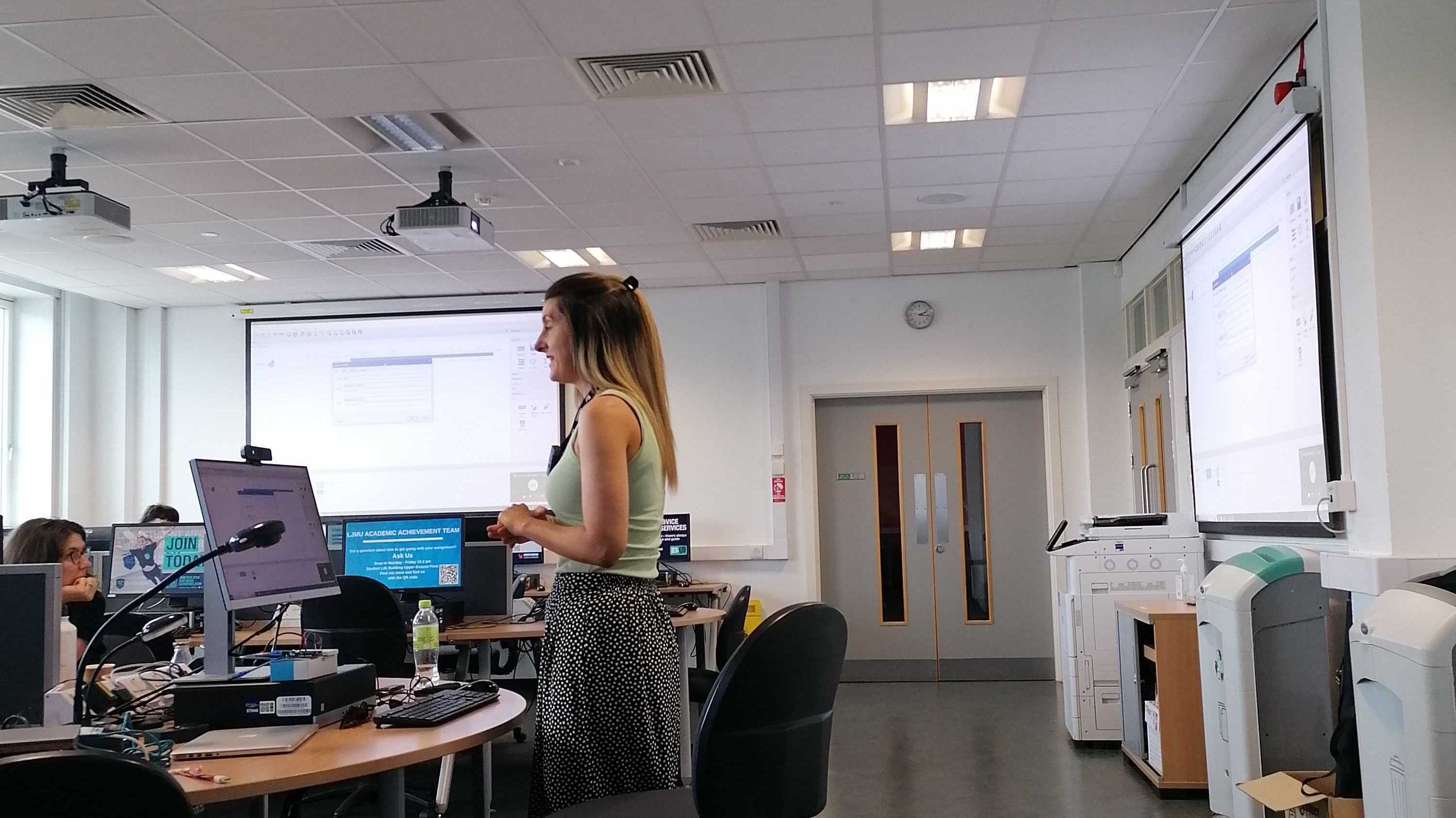
In person or virtual, we can develop bespoke content to suit your needs.
We can cover a range of topics, including:
Builder basics. Introduce your team to what is possible using the Builder interface to create a huge range of studies
Running experiments online with Pavlovia.
Get started with Python coding by making experiments - a fun, visual, way to learn how to code.
Learn how to create experiments that interact with a range of hardware, Eyetracking, EEG, fMRI, or something else!
Content tailored to Undergraduate, Postgraduate or Research Staff level.
Open science
We make all of the materials from our workshops open access! Click the cards below to download as pdfs or power point slides. Please feel free to re-use materials in your teaching and your own workshops!
A full workshop series from getting started with PsychoPy Builder to creating eye tracking experiments
Beginner Builder Pavlovia Python Code Eye Tracking
Part of day 1 of our virtual PsychoPy workshop
Beginner Builder Memory Tasks
Presented at: European Conference on Visual Perception, ECVP, 2024
Staircases Psychophysics online
Presented at: University of Nottingham, BSc course
Data extraction Python
Presented at: University College London, November 15th 2023
Data extraction Python
PsychoPy Builder Presenting stimuli Gathering keyboard responses Setting up trial lists
PsychoPy Builder Counterbalancing Adaptive procedures Staircases Branched designs
Pavlovia Daisy chaining with recruitment platforms Surveys and Questionnaires with Pavlovia Surveys Counterbalancing online Multisessrion testing
Python code PsychoPy library
EEG Eyetracking fMRI Serial and parallel ports
💬 What Attendees say
The best workshop I have ever been to. It had the perfect pace and amount of interactions. All of the examples were buildable and relatable for researchers of all types. Clearly, a lot of thought and planning went into the format and content.
This was a very well-structured and compact training, with a pace that felt just right throughout. It provided a clear and practical introduction, and I feel that after completing it, one can realistically start designing and running their own experiment. Just as importantly, it also gives participants the tools to know where to look for further information independently whenever needed.
I highly recommend the PsychoPy workshop! It is tailored for everyone conducting experimental research – from beginners new to PsychoPy through to those wishing to learn its more advanced functionalities. I really appreciated the interactive and collaborative format of the workshop, which allowed us to present our own research and get conceptual and technical feedback regarding the implementation of specific features in PsychoPy. Kim and Rebecca presented the content in a very accessible way and took an individual approach, repeating explanations when needed and answering everyone’s questions. You can expect to learn a lot and build experiments independently after attending four half-day sessions!
Virtual PsychoPy & Pavlovia Workshop was a really uplifting and intensive course that left me inspired and encouraged! I learned tools for specific use as well as creative solutions. Becca and Kim made everyone feel welcome and safe to ask any questions they had. It was especially great to connect with other researchers - the challenges of an online format where solved cleverly!
Rebecca and Kim gave a fantastic, in-depth tutorial on Psychopy and Pavlovia. They are incredibly knowledgeable and patient and took time to ensure that course attendees were keeping up with the content. With this aim they gave considerable one-on-one, dedicated support where needed, and allowed plenty time for questions throughout. Thank you!
I’ve only been using PsychoPy for a few months, but already know I plan to be using it throughout my career. It is extremely powerful, able to accommodate a huge range of tasks, while remaining relatively intuitive and easy to learn. Although it can be self-taught (with a lot of help from the documentation, tutorials, and forum), the workshop is definitely worth it to build a solid foundation for using it. It is especially good if you are interested in open science and scientific citizenship, as it allows for easy documentation and sharing of programmed tasks.
I’m grateful to the PsychoPy team for organizing an excellent workshop. The hands-on practice sessions were incredibly valuable, allowing us to create our own experiments. Rebecca was an exceptional trainer, and Sue provided great support in designing experiments during each session. Kim was also very helpful in setting up hardware connections. I highly recommend attending their workshop if you’re looking to program experiments with PsychoPy.
The three workshops I attended were really fundamental in understanding the basics of the logic of designing and programming psychopy experiments. The lecturers were very helpful and precise. Thank you very much for the valuable events you organised.
There is great material on YouTube for learning psychopy, but the live workshops are interactive and we can meet the team, ask questions, and get to understand the broader logic of the psychopy/Pavlovia project. It is pleasant to get to know the people making it happen, and it is really great value for the knowledge you get.
If you’re looking to get started with PsychoPy, this workshop is an absolute must-attend. By following the patient tutors step by step to create experiments, I’ve learned a lot, even some insights I hadn’t anticipated.
You can go from being completely lost at how to use psychopy to feeling super confident in your abilities over the workshop. I’ve gone from 0 experiments to having 2.5 experiments built! I’m certain this would have taken me as many months to get to this stage if I was on my own.If you’re interested in running studies in the lab or online then this workshop is a must!
I would highly recommend this workshop for anyone interested in using PsychoPy for their research! The workshop is extremely well organised and Becca, Jon and the rest of the team do a fantastic job in helping you develop the confidence and skills to effectively use PsychoPy. Whether you have a specific experiment that you’d like to build, or simply want to learn the basics, this workshop caters to researchers of all programming levels.
Useful if you are totally beginner with PsychoPy